
Announcing 3DMark CPU Rumble - our new custom gaming CPU benchmark
November 25, 2026
We’re very excited to announce CPU Rumble – the first of two new CPU benchmarks we’re creating to make understanding how your CPU affects gaming performance easy. CPU Rumble launches today on the Google Play Store for Android, and the Apple Appstore for iOS – for free!
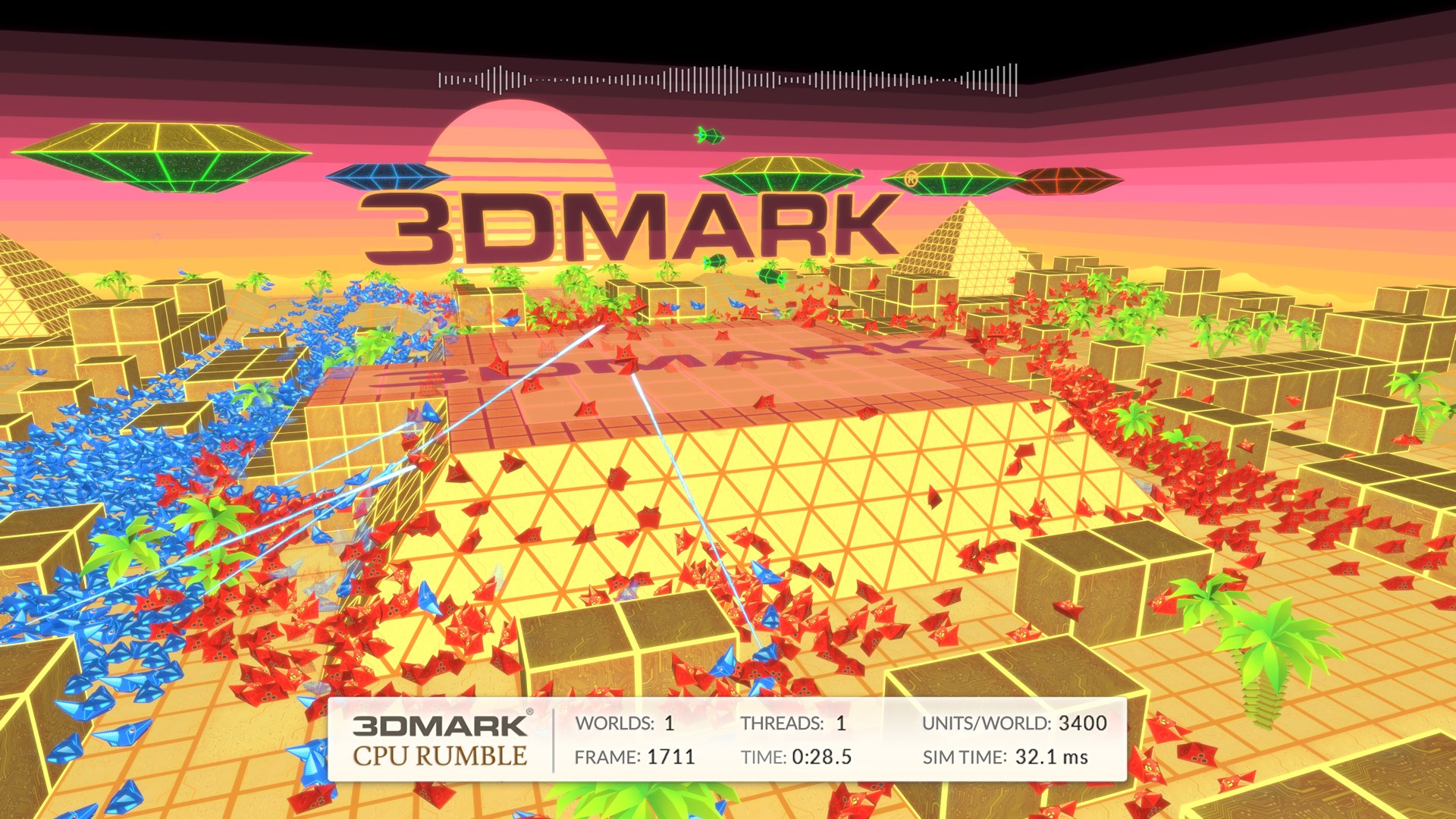
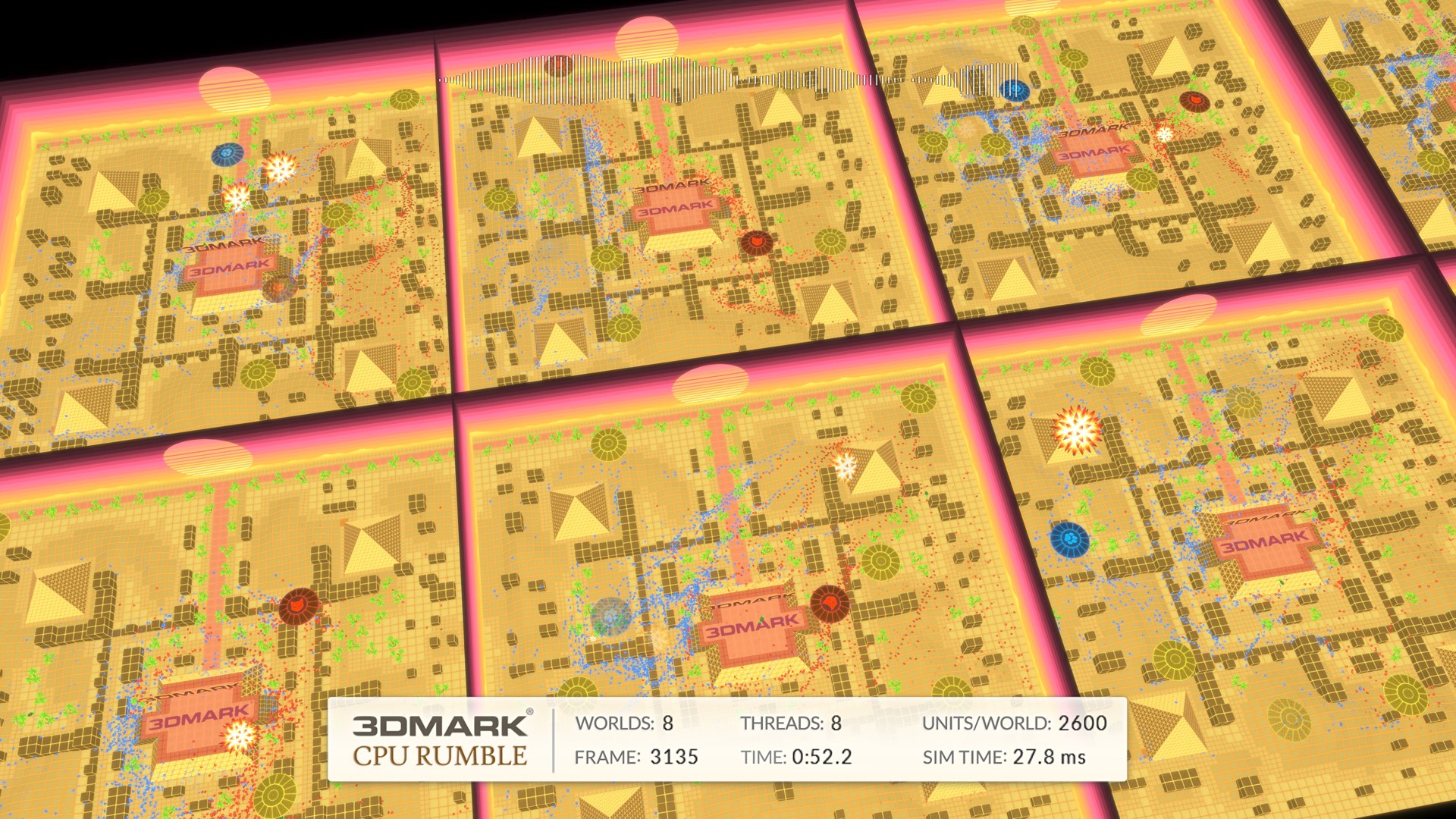
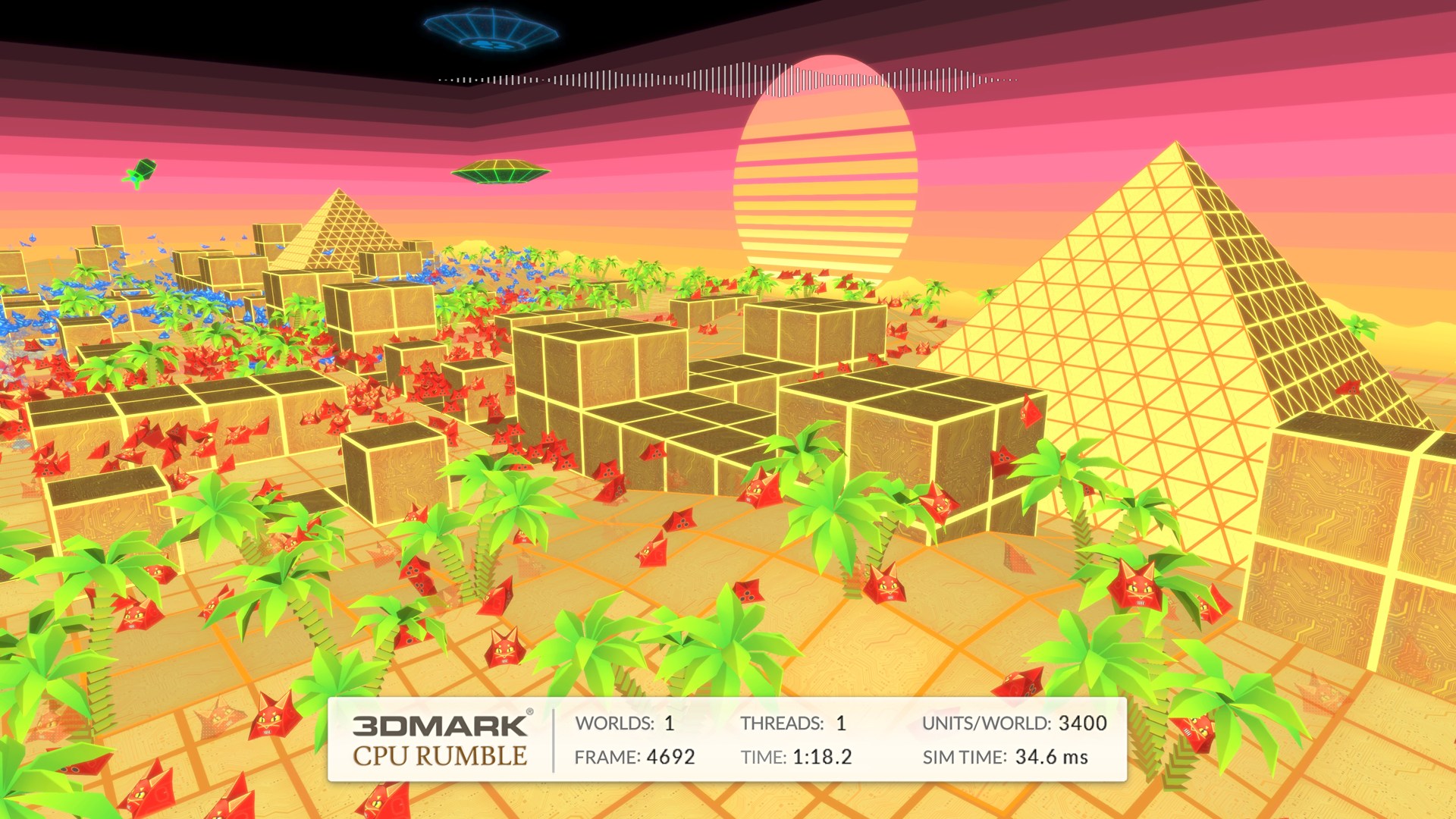
3DMark CPU Rumble’s visual design is a throwback to classic games from even beyond the first 3DMark benchmark. It has minimal graphical effects to reduce the impact of GPU performance on benchmark results, but still shows off an exciting benchmark scene where you can see the real-time work being done by your CPU in a game-like environment.
How have we designed 3DMark CPU Rumble?
In many currently available CPU benchmarks, your result mainly reflects the performance when either a single thread is used, or when the CPU is working at its maximum thread count. This can be useful for understanding the raw maximum performance of a CPU ideal scenarios – but modern games rarely, if ever, use a CPU in this way.
In most cases, your game of choice will use somewhere between 2 and 8 CPU threads, with one thread acting as a “main” thread that handles the most critical tasks for keeping the game running, with the other “worker” threads handling tasks such as audio, NPC AI, or assets. This is how you can sometimes experience game audio issues if your CPU is struggling, without the entire game crashing.
In the case of mobile games, their implementations make this approach even more obvious, as mobile CPUs have a variety of different core types that balance performance and energy efficiency.
CPU Rumble is designed to test the performance of a CPU in a scenario that closely mimics a game, while minimizing the non-deterministic component of them – something crucial to the development of a reliable benchmark. We’ve achieved this balance by using the same APIs and libraries popular among game developers:
| Component | Library | Explanation | |
| Multithreading Model | EnkiTS | Many game engines have custom implementations in this case, but typically these do not have a large impact on performance. | |
| Physics Engine | Jolt | Jolt is one of the most popular physics engines - used by many games across mobile, console and PC. Its simulations are deterministic, making it suited for implementation in a benchmark | |
| Pathfinding | Recast Navigation | Recast is a library for handling Navmeshes – a technique used for handling pathfinding in 3D Games. Recast was chosen as it is the industry standard – the most likely one being used when you’re gaming. | |
| Unit Targeting | Custom | Custom implementation with reference to industry standards | |
| Audio | Miniaudio | Like in a game, audio is processed when there is space in the worker threads. The audio is processed with deterministic amount of 1/60 seconds every frame for each scene. As the sound would not be seamless, it is not played through speakers. | |
| Memory access | Custom | Custom implementation to align with real-world gaming implementations but also keep the workload deterministic. | |
What is determinism and why is it important?
When something is deterministic, it means if you repeat it, the behaviour should be identical. In many games - even in a game with benchmark mode - there are small differences between each run that would make each test workload vary slightly. This is by no means a bad thing for a game – in many of the top games, unpredictability is part of what makes them exciting!
For a benchmark though, a significant amount of our development time is spent finding the perfect balance between making a benchmark as close to a real game while minimizing the amount of randomness engine physics, NPC behaviour or even audio playback could have.
Finally, as with many of our other 3DMark benchmarks, CPU Rumble comes with a stress test. Our stress tests run the benchmark multiple times, allowing for you to see if the device becomes thermally throttled over time. Unlike our GPU stress tests, the device will run the CPU Rumble workload as many times as possible within a 20-minute window rather than 20 runs at the highest frame rate possible.
Available Now!
3DMark CPU Rumble is out now, November 25 - just to update to the latest version of 3DMark from the Apple Appstore or Google Play Store.
Recent news
-
Announcing 3DMark CPU Rumble - our new custom gaming CPU benchmark
November 25, 2026
-
The Multitasking Blind Spot in PC Performance Testing
November 11, 2026
-
Procyon® Is Ready to Benchmark NVIDIA RTX Spark
October 16, 2026
-
RAM Prices Are Forcing a Rethink of the PC Refresh Cycle
October 2, 2026
-
Seasonic joins as a sponsor of the next 3DMark GPU Benchmark
July 24, 2026
-
Announcing our next generation 3DMark GPU Benchmark and its first sponsor
June 3, 2026
-
Launching Procyon Essentials: a browser-focused benchmark for multitasking professionals
May 5, 2026
-
3DMark on MacOS now available directly from UL Solutions.
April 22, 2026
-
3DMark delisting of REDMAGIC 11 Pro phones
April 9, 2026
-
Introducing Computer Vision 2.0, Our Next‑Generation AI Hardware Benchmark
March 30, 2026
-
Procyon® AI Benchmarks Provide Full Coverage and Actionable Performance Insights
January 13, 2026
-
Procyon Labs launches with FLUX.1 AI Image Generation Demo
November 4, 2025
-
3DMark Solar Bay Extreme is available now!
August 20, 2025
-
3DMark Speed Way Teams up with PC Building Simulator 2!
July 17, 2025
-
New Procyon AI Benchmark for Macs now available
June 25, 2025